ScienceExplainer
‘220 minus your age’ gets endurance athletes wrong, survey of 4,375 finds
Age-based formulas underestimated athletes’ real maximum heart rates by five to six beats a minute on average, and could miss by 20. If your training zones come from a formula, they may be off.

“Subtract your age from 220.” For decades it has been the first thing many athletes are told about heart rate, and it still sits behind the default training zones in countless apps and watches.
A study published in April in Frontiers in Sports and Active Living adds to the evidence that, for endurance athletes, it is not good enough.
What the researchers did
The team (Åsmund Ausland and Stephen Seiler of the University of Agder in Norway, and Bence Kelemen in Hungary) surveyed 4,375 endurance athletes from across the world between November 2022 and January 2023. Athletes reported the highest heart rate they had recorded during maximal training or racing efforts, along with their resting heart rate, training volume and history.
Seiler is one of the best-known researchers in endurance training, widely credited with describing the “polarised” intensity distribution of elite endurance athletes.
What they found
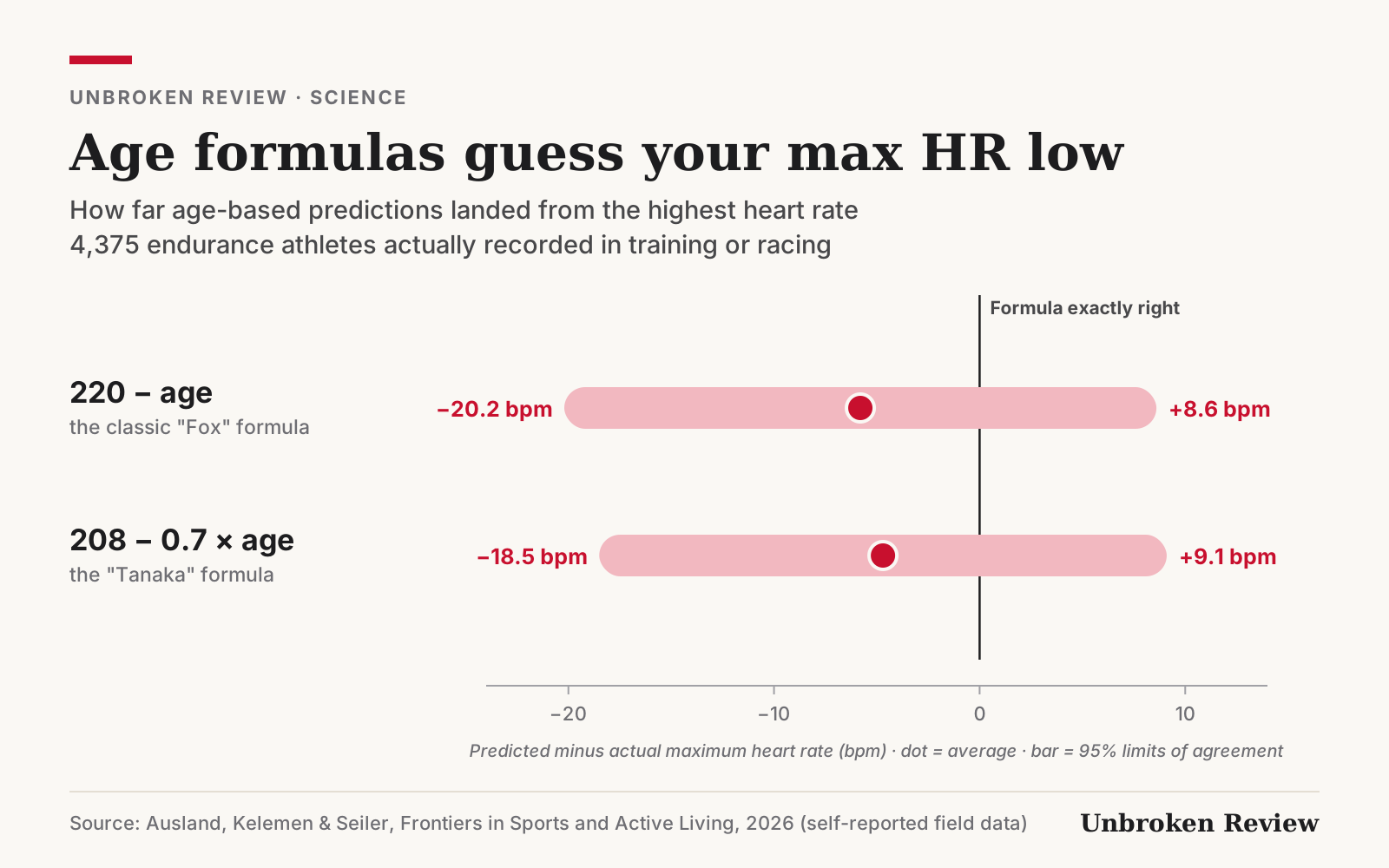
As expected, maximum heart rate fell with age: the correlation was strong (r = −0.60). But the commonly used formulas consistently guessed too low. Both “220 minus age” (often called the Fox formula) and the more modern Tanaka formula (208 minus 0.7 × age) underestimated athletes’ self-reported maximum heart rate by five to six beats per minute on average.
The averages hide the bigger problem: the spread. For any individual, the Fox formula’s prediction could be anywhere from about 20 beats too low to 9 beats too high, and Tanaka’s from about 18 too low to 9 too high.
The study found no meaningful difference between men and women. Resting heart rate was lower in athletes who trained more hours each week, though the relationship was modest.
Why it matters
Heart-rate training zones are usually calculated as percentages of maximum heart rate, or of heart-rate reserve (the gap between resting and maximum). If the maximum is wrong, every zone built on it is wrong too.
For an athlete whose true maximum is 15 beats higher than a formula predicts, “easy” runs at the formula’s zone 2 may be far easier than intended, and threshold sessions may be pitched too low. For one whose maximum is lower than predicted, the reverse happens, and easy days may quietly become moderate ones.
What to do instead
The authors recommend individualised, context-specific assessment of maximum heart rate rather than reliance on age-based predictions.
In practice, that can mean a supervised maximal test, or using the highest reliable value from a chest-strap heart-rate monitor during an all-out effort, such as the end of a hard race. Anyone with heart disease, symptoms or risk factors should speak to a doctor before attempting maximal efforts.
Many athletes now also anchor zones to other markers (lactate threshold, functional threshold power or pace, or perceived exertion), which do not depend on maximum heart rate at all. The simplest lesson of the study is that if your zones came from a formula, they are a starting point, not a measurement.