ScienceExplainer
Heavy lifting made endurance cyclists faster, without raising their VO2max
Across 17 studies, adding heavy strength training to cycling improved time-trial performance, efficiency and anaerobic power. The engine stayed the same size. It just wasted less.

Endurance athletes have long been wary of the weights room. Lifting heavy, the argument goes, adds muscle that has to be carried, and steals time and energy from the riding that actually builds endurance.
A meta-analysis published in the January issue of the European Journal of Applied Physiology adds to the evidence that, for cyclists at least, the argument is wrong.
What the researchers did
Researchers at Pablo de Olavide University in Seville and Universidad Andrés Bello in Chile pooled 17 studies of endurance cyclists: 262 riders, 60 of them women, with an average starting VO2max of 61 ml/kg/min, the range of well-trained amateurs. In each study, one group added heavy strength training, loads of at least 80 per cent of the most they could lift once, to their cycling for between 5 and 25 weeks, one to three sessions a week. A comparison group did the cycling alone.
What they found
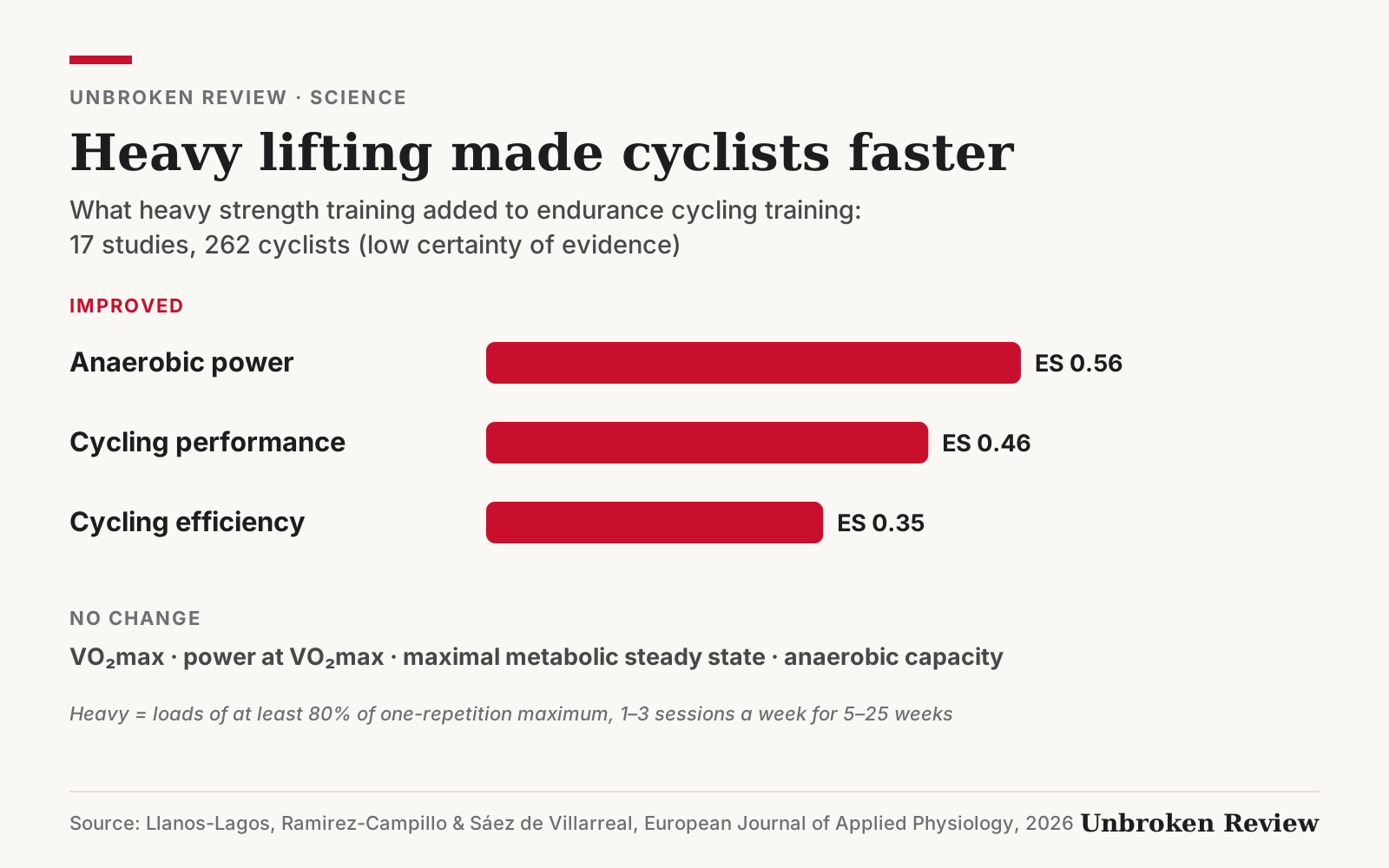
Compared with cycling alone, adding heavy strength training improved:
- Cycling performance: time to exhaustion and time-trial results combined (effect size 0.46)
- Cycling efficiency: how much power a rider produces for a given oxygen cost (0.35)
- Anaerobic power (0.56)
It did not change VO2max, power at VO2max, the maximal metabolic steady state (roughly, threshold) or anaerobic capacity. And the benefits did not depend on sex, body size, performance level, strength-training experience, or how long or often the programme ran.
Why it works
The pattern is telling. Heavy lifting did not make the cyclists’ engines bigger: VO2max and threshold were unchanged. What it changed was efficiency and top-end power, and that was enough to make them faster.
That fits the leading explanation for strength training’s benefits in endurance sport: stronger muscles can produce each pedal stroke using a smaller fraction of their maximum force, which may delay fatigue and allow the same power with less effort. Strength training also changes how the nervous system recruits muscle: neural adaptations that can occur without large gains in muscle size.
What it means
For cyclists (and plausibly for runners and triathletes, where similar findings have been reported), heavy strength training appears to be a performance tool rather than a distraction. One or two sessions a week, focused on heavy, low-repetition lifts, fit easily into most training weeks.
The details still matter. Heavy lifting is a skill and a load in its own right, best introduced gradually, in the off-season or base period, and scheduled so it does not compromise the key endurance sessions. The minimum effective dose here is small. The research suggests it is worth finding.