A watch that reads your sweat: what a new sensor can and cannot yet do
Japanese researchers have built a wrist-worn device that tracks sodium and potassium in sweat continuously. It worked through a construction worker’s shift. It has not yet been shown to be accurate.

Anyone who has finished a hot race with salt crusted on their face knows that sweat carries more than water. How much sodium and potassium each person loses varies widely, and getting replacement wrong can matter in long events. Measuring those losses has usually meant collecting sweat in patches and sending it to a laboratory.
Researchers at Tokyo University of Science have built a watch that tries to do it on the wrist, continuously. The work, led by associate professor Isao Shitanda, is published in ACS Omega.
How it works
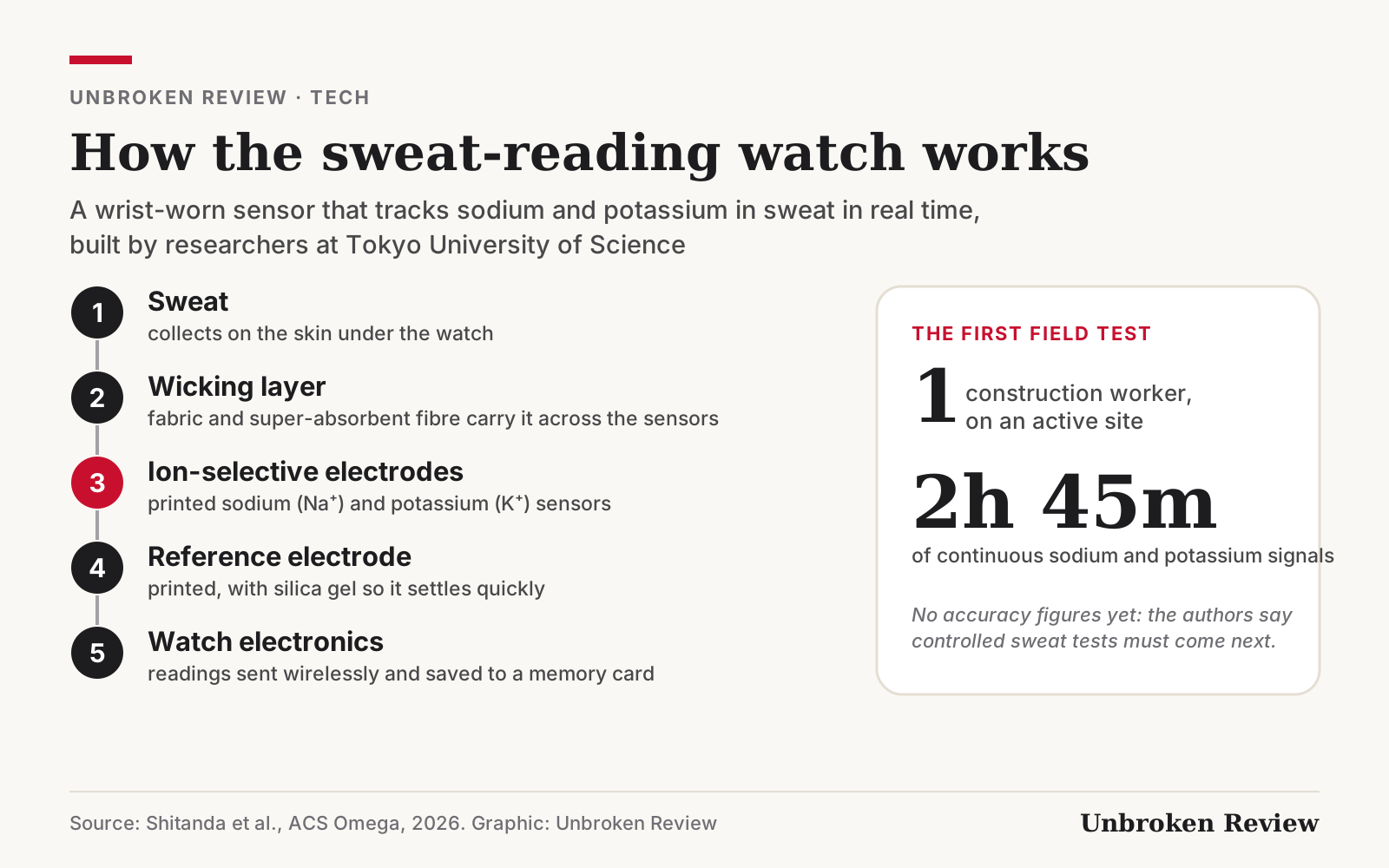
The device uses printed ion-selective electrodes: sensors that “measure a voltage that changes with the concentration of a specific ion”, in this case sodium and potassium. Those sensors need a stable reference to compare against, and printed reference electrodes can take a long time to settle. The team added silica gel to theirs so it stabilises quickly.
A layer of fabric and super-absorbent fibre over the electrodes wicks sweat across the sensors. A custom watch processes the signals, sends them wirelessly and saves them to a memory card.
The first test
The team tested the watch on one person: a construction worker, during a normal working day on an active site, including breaks, drinks and meals. It recorded signals that responded to sodium and potassium for about 2 hours 45 minutes while the worker moved around.
That is a proof that the device can work outside a laboratory. It is not yet evidence that its readings are accurate. The researchers did not report how its values compared with laboratory measurements, and say quantitative sweat analysis “will require controlled sweating experiments and further validation”.
Where sweat sensing stands
A review of sweat-sensing patches for athletes, published in Analytical Methods in June, lists the obstacles that remain: sensors drift over time, adhesion fails when people move, manufacturing at scale is difficult, and the relationship between what is in sweat and what is in blood is still debated. Its authors caution against treating sweat patches as “a mature plug-and-play platform”.
The Tokyo team’s approach has one practical advantage: because the electrodes are printed, they could be cheap to make in large numbers. The authors suggest that, combined with measurements of sweat volume and drinking, such devices could eventually help manage hydration in hot conditions, for workers as well as athletes.