RunningExplainer
Tigst Assefa ran the last two kilometres in Berlin on a ruptured Achilles. What the research says about coming back
Her manager has suggested a return in about seven months, possibly at the London Marathon. Studies of thousands of patients show most people do return to sport, but almost none of that evidence comes from elite distance runners.

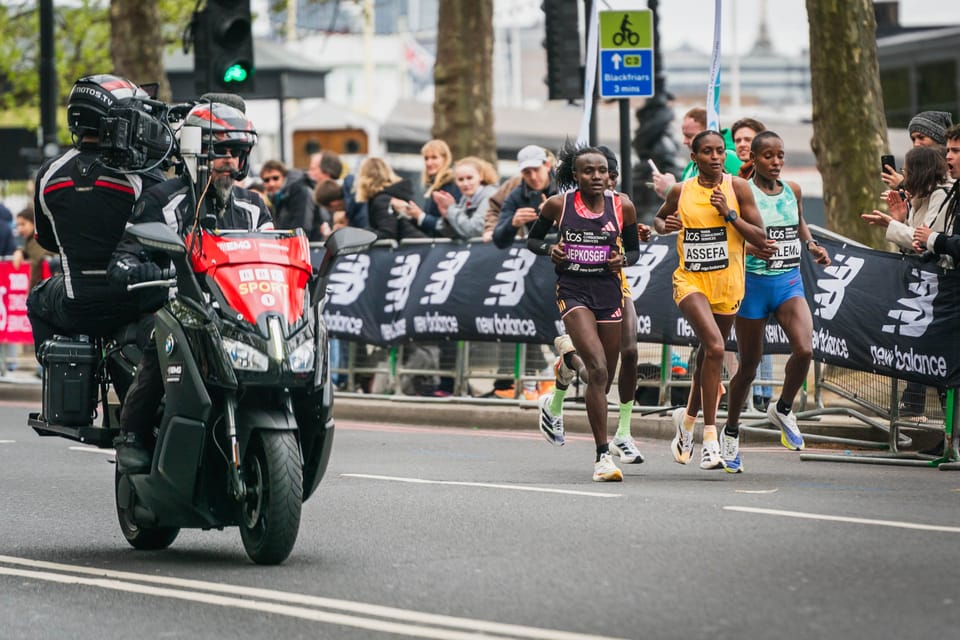
Tigst Assefa won the Berlin Marathon on 27 September with a complete rupture of her right Achilles tendon, her manager has confirmed. She had surgery on 28 September and has told the running community she intends to return to Berlin and break the world record.
The Ethiopian was inside world-record pace until late in the race and finished in a course record of 2 hours 11 minutes 4 seconds, limping visibly over the final stretch. Her manager, Gianni Demadonna, told AFP that she first felt pain after 31 km. “The tendon was completely gone when she ran the last two kilometres,” he said.
Demadonna told the Associated Press that the rupture happened at about 40 km. “She was no longer able to run, because when she was going to put her foot on the ground she had no power,” he said.
Surgery in Bavaria
Assefa was taken to hospital in Berlin after the race and then flown to Bavaria, where she was operated on on 28 September by Dr Johannes Gabel, head of foot and ankle surgery at the BG Unfallklinik Murnau trauma hospital south of Munich, Marathon Handbook reported.
In a message released by the Berlin organisers, SCC Events, on 29 September, she said: “My surgery went well. I am overwhelmed by the tremendous support I have received from all over the world.” She added: “I will definitely come back to Berlin, and then I will break the world record.”
Her team’s estimates of how long that will take have varied. Demadonna told the AP she would need crutches for about six weeks, that walking and cycling would come before running, and that running might start in about three months. He suggested about seven months before she could compete again, possibly at the London Marathon in April 2027, but added: “We have to stay patient and see what the doctor will say.” Asked by Marathon Handbook when she would return, he said: “We don’t know.”
What the evidence says about return
The Achilles is the tendon that joins the calf muscles to the heel bone, and every running stride loads it. A complete rupture means the tendon has torn through.
The largest review of return to sport, published in the British Journal of Sports Medicine in 2016, pooled 108 studies covering 6,506 patients. Overall, 80% returned to play. But the authors found that studies which clearly defined what “returning” meant reported lower rates than those that did not, so the true figure depends on how strictly it is measured.
A 2022 scoping review in the same journal looked only at elite athletes treated with surgery: 709 men across 13 studies in the NBA, NFL, Major League Baseball, US college football and professional soccer. Between 61% and 100% returned. Basketball players performed worse afterwards than before and worse than uninjured players, and the authors suggested that sports needing explosive push-off from the ankle may be hit hardest. Baseball players showed no significant decline.
For runners, one of the most relevant data sets comes from the US Navy. A 2025 study in Clinical Orthopaedics and Related Research compared fitness test results for service members before and after Achilles repair. Of 1,057 people who had surgery, 451 had usable tests before and after. Those who ran the 1.5-mile test were on average 41 seconds slower after surgery, but those who took a second test after surgery improved by 18 seconds, suggesting recovery continues beyond the first year. The group was 94% male, with an average age of 33.
When is it safe to run?
There is still no agreed test for that. In a 2026 Delphi study in Sports Medicine, a panel of international Achilles specialists agreed on seven criteria: no pain in daily life, no pain during or after rehabilitation sessions, walking without a limp, walking on tiptoes, ten single-leg heel raises, good single-leg balance, and the patient feeling psychologically ready. The authors stress that these are expert opinion and still need to be tested in patients before being used as rules.
The limits
None of these studies is about elite female marathon runners. The elite review covered only men in team sports, and the Navy group was mostly men running 1.5 miles. A marathon places a different, more prolonged load on the tendon, and there is little published evidence on how distance runners at Assefa’s level fare after a full rupture. Her own timeline will be set by her surgeon and medical team, not by averages from other sports.