
RunningFeature
1:59:30, six months on: how the two-hour marathon finally fell, and what it changed
In April, Sabastian Sawe became the first person to run a marathon under two hours in a race that counts. The details of that run, and of the season since, explain why it happened when it did.


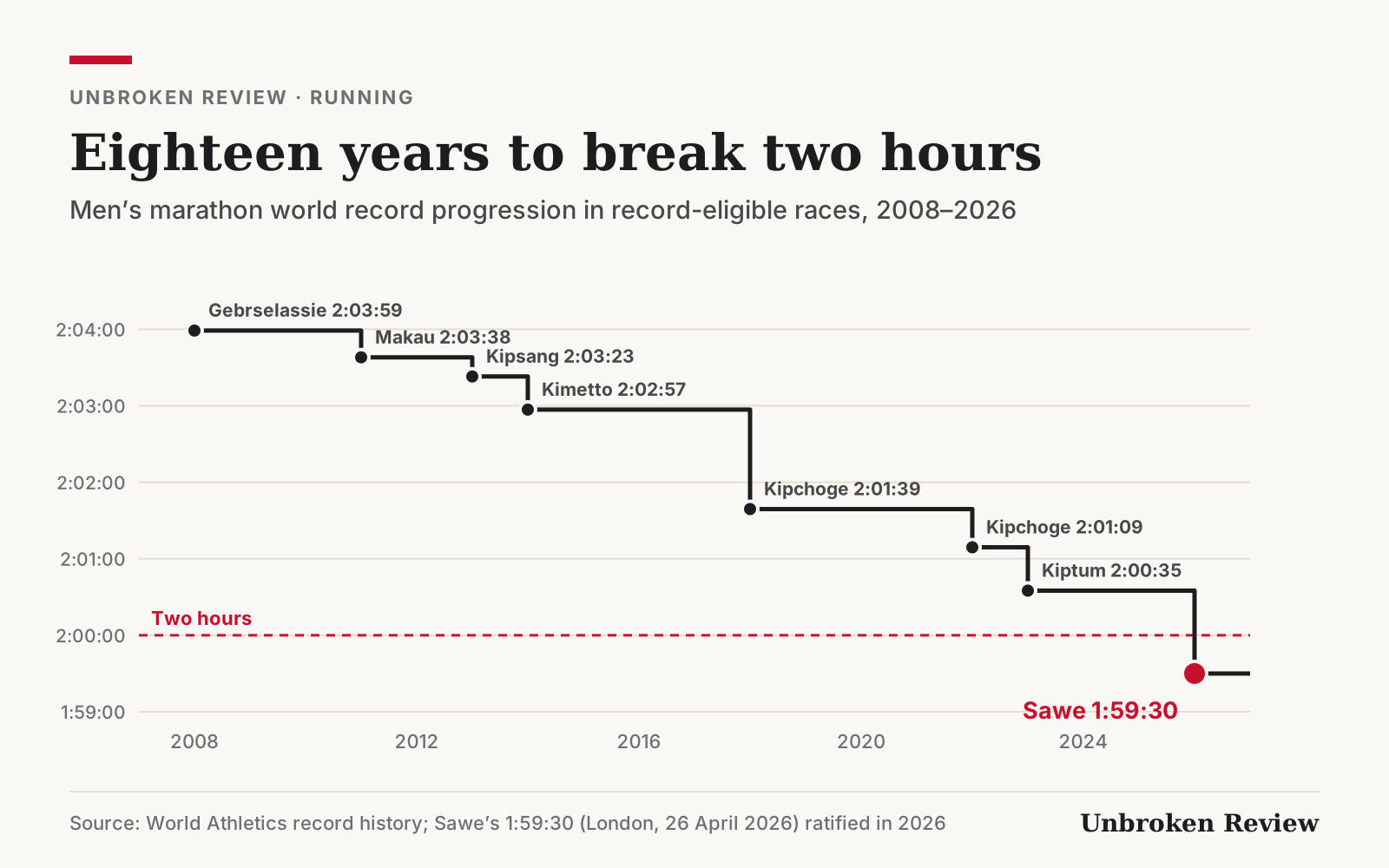
For most of the past decade the two-hour marathon was an argument rather than a time. Eliud Kipchoge ran 1:59:40 in Vienna in 2019, but in a staged event with rotating pacemakers and a pace car that could never count as a record. In a real race, the record crept downwards a few seconds at a time.
Then, on 26 April in London, Sabastian Sawe ran 1:59:30.
He did not just break the barrier. The man who chased him, Ethiopia’s Yomif Kejelcha, ran 1:59:41, in his first marathon. Uganda’s Jacob Kiplimo, in third, ran 2:00:28, also inside the old world record. According to the race’s own data, all of the top five set personal bests.
Six months later, with the record ratified and the autumn marathons run, it is possible to see the run more clearly: not as a freak, but as the end point of a long slope.
How the race unfolded
The first half was fast but controlled. A group of six (Sawe, Kejelcha, Kiplimo, Olympic champion Tamirat Tola, Deresa Geleta and Amos Kipruto) followed the pacemakers through halfway in 1:00:29, close to the planned 60:30.
The pacemakers sheltered the group from the wind until about 25 km. Then Sawe, rather than waiting, began to press. By 29 km only Kejelcha could stay with him, with Kiplimo dropping back.
At 30 km the pair were still only on course for roughly 2:01. What changed the race was the next five kilometres: Sawe covered 30 to 35 km in 13 minutes 54 seconds, bringing the projection down to around 2:00:30. Kejelcha held on until the 25th mile. Sawe ran the final 2.195 km alone, in 5 minutes 51 seconds.
One detail from that day shows how scrutinised such a run now is. Timing data initially credited Sawe with a 4:12 24th mile, which would have been the fastest mile split recorded in any marathon. Within a week, analysis showed the split had probably been mismeasured, and the race’s timing company removed it from the record.
The preparation behind it
Sawe was not an unknown. He won on his debut in Valencia in 2024 in 2:02:05, then took the London and Berlin titles in 2025. According to reporting on his build-up, he averaged around 200 km a week in the six weeks before London, and he raced in a lightweight version of Adidas’s super-shoe.
Credibility was part of the preparation too. In the doping-scarred climate of Kenyan distance running, Sawe had volunteered for an unusually heavy programme of out-of-competition testing before his 2025 Berlin win (25 tests from the Athletics Integrity Unit) and additional testing funded by his sponsor before London. World Athletics ratified the record in July, according to Kenyan media reports.
What has changed since
Records rarely stand alone, and the autumn has shown how far the event has moved.
In Chicago on Sunday, Amos Kipruto, one of the six men in the London lead group, won in 2:01:09, the same time as Kipchoge’s world record of only four years ago. In Berlin last month, Guye Adola ran 2:02:50. Kejelcha’s 1:59:41 means two men have now run under two hours in a record-eligible race, and neither did it in a staged attempt.
The women’s event is moving too. On the same day in London, Tigst Assefa set a women-only world record of 2:15:41, the first time three women had run under 2:16 in one race. In Berlin she reached 40 km inside world-record pace before injury slowed her.
Sawe himself withdrew from Berlin, where he was the defending champion, with an injury a month before the race, a reminder that the bodies producing these times are being asked to absorb extraordinary training loads.
Why now?
There is no single answer, and anyone who offers one is selling something. The ingredients are visible, though: a deep generation of East African athletes who move up from the track and half marathon younger and faster; carbon-plated shoes with highly resilient foams; carbohydrate intakes during races that would have been unthinkable a decade ago; and courses, pacing and race organisation built around fast times.
What Sawe’s run demonstrated is that, with all of that in place, the barrier was a matter of nerve and timing as much as physiology. He ran the fastest section of his race when the conventional plan said to wait.
The two-hour marathon is no longer the limit. The question is now how far below it the event will go, and whether the athletes chasing those times can stay healthy enough to keep trying.


