Peres Jepchirchir banned for three years for EPO and loses her Sydney Marathon title
The Olympic and world marathon champion admitted the violations. The Athletics Integrity Unit also banned world half marathon silver medallist Veronica Loleo for three years and Ronald Korir for six.

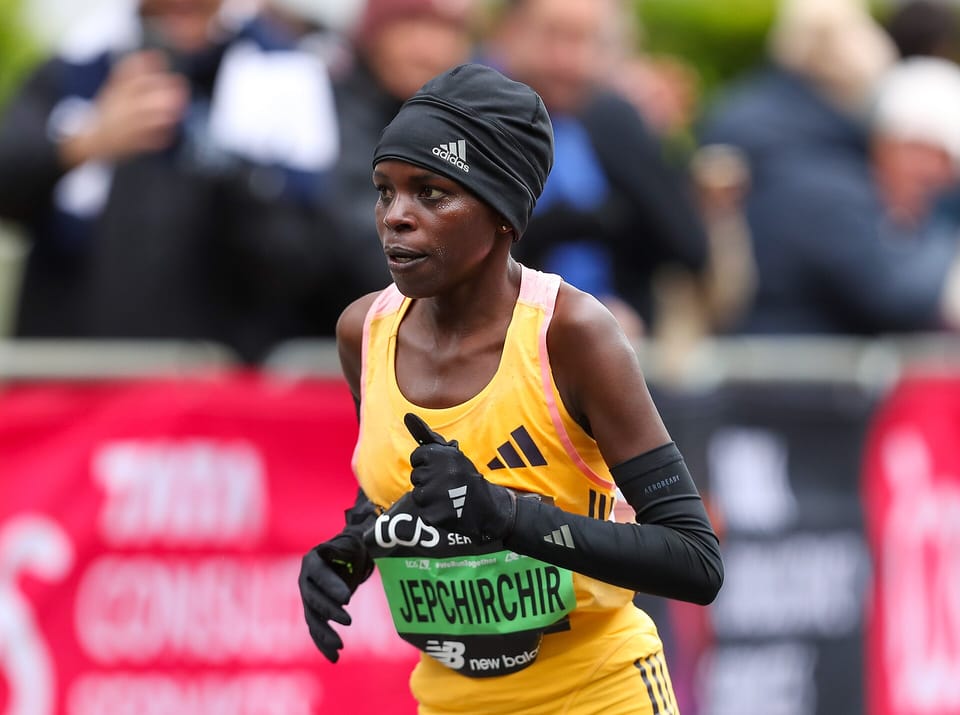
Peres Jepchirchir, the Olympic marathon champion from Tokyo 2021 and the reigning world champion, has been banned for three years after admitting to using the blood booster EPO, the Athletics Integrity Unit (AIU) announced on 19 November.
All of her results from 17 July 2026 onwards are disqualified, including her victory at the Sydney Marathon on 30 August. Irine Cheptai, who finished second in Sydney, is set to be named the 2026 women’s champion, according to Reuters and Al Jazeera.
The AIU announced two more Kenyan cases on the same day. Veronica Loleo, the half marathon silver medallist at the 2026 World Road Running Championships, was also banned for three years for EPO. Ronald Korir, fourth at the 2023 Berlin Marathon, was banned for six years over abnormalities in his Athlete Biological Passport.
How the Jepchirchir case unfolded
An out-of-competition sample collected in Kenya before the Sydney race returned an adverse analytical finding for EPO on 17 September, according to the AIU statement as reported by Reuters and Athletics Illustrated. Her in-competition test in Sydney was negative, Al Jazeera reported.
She was provisionally suspended on 20 October. In an interview that day she denied using EPO and said she did not know how the finding had occurred, Athletics Illustrated reported. She later signed an admission form, accepting violations of the rules on the presence and the use of a prohibited substance, and the disqualification of her results.
EPO is a non-specified substance, and the standard sanction was four years. Jepchirchir and Loleo each received a one-year reduction for admitting the violation early and accepting the sanction, Athletics Illustrated and Kenyans.co.ke reported. AFP reported that Jepchirchir’s ban runs from 20 October.
The 33-year-old won the New York Marathon in 2021, Boston in 2022 and London in 2024, as well as Olympic gold in 2021 and the world title in 2025.
Loleo’s world silver is cancelled
Blood and urine samples collected from Loleo out of competition in Kenya on 6 September returned adverse findings for EPO, according to Athletics Illustrated and Kenyans.co.ke. Her results from that date are disqualified, which removes her silver medal from the World Road Running Championships half marathon.
According to Athletics Illustrated, Loleo told investigators she did not know how the finding had occurred, but said she had received an injection for an injury and pain before the samples were taken. She could not recall the name of the drug. She chose to admit the violations rather than submit a written explanation.
Six years for Korir
Korir’s case did not rest on a positive test. The AIU analysed 20 blood samples collected from him between 6 May 2023 and 18 August 2025, according to Al Jazeera and Athletics Illustrated. An expert panel found abnormal values indicating “likely doping” in samples taken from January to March 2024, before the Hamburg Marathon, and in January and February 2025, before the Osaka Marathon, Athletics Illustrated and Kenyans.co.ke reported.
Korir, 35, was charged and provisionally suspended on 25 September. According to Athletics Illustrated, he twice failed to provide a written explanation and did not respond to the charge by the deadline, so under the rules he was deemed to have admitted the violation and waived a hearing. His results from 19 January 2024, the date of the first abnormal sample, are disqualified, the outlet reported. The reports we read did not explain why his sanction was six years rather than the standard four.
“A long way to go”
Clothier said Kenyan authorities had “made a lot of progress in the fight against doping in the last five years”, but that “these cases highlight that there is still a long way to go”, according to Kenyans.co.ke and Reuters. He added that the Kenyan government “has committed to further strengthen the Anti-Doping Agency of Kenya”, and that the AIU would “discuss the details behind these commitments with the Kenyan government in the coming months”, Athletics Illustrated reported.
The bans follow a run of high-profile marathon cases. In October the AIU banned Ruti Aga, the 2019 Tokyo Marathon champion, for six years. Al Jazeera noted that Ruth Chepng’etich was banned for three years in 2025, and that Albert Korir, a former New York winner and a different athlete from Ronald Korir, received five years in March 2026.