
MindExplainer
How slowly should you breathe to calm down? Two 2026 trials give a more nuanced answer
One study found that breathing at the slowest personalised rate relaxed people most. Another found that finding your exact “resonance” breathing rate made no difference over four weeks. Together they point to something simpler.

Breathing is the one vital function we can control directly as well as leave on autopilot. That dual control is why slow, paced breathing has become one of the most popular tools for managing stress, in clinics, in apps and in the pre-race routines of athletes.
But “breathe slowly” leaves a lot unsaid. How slowly? For how long? And does the precise rate matter? Two trials published this year approach those questions from different directions.
Study one: slower is calmer
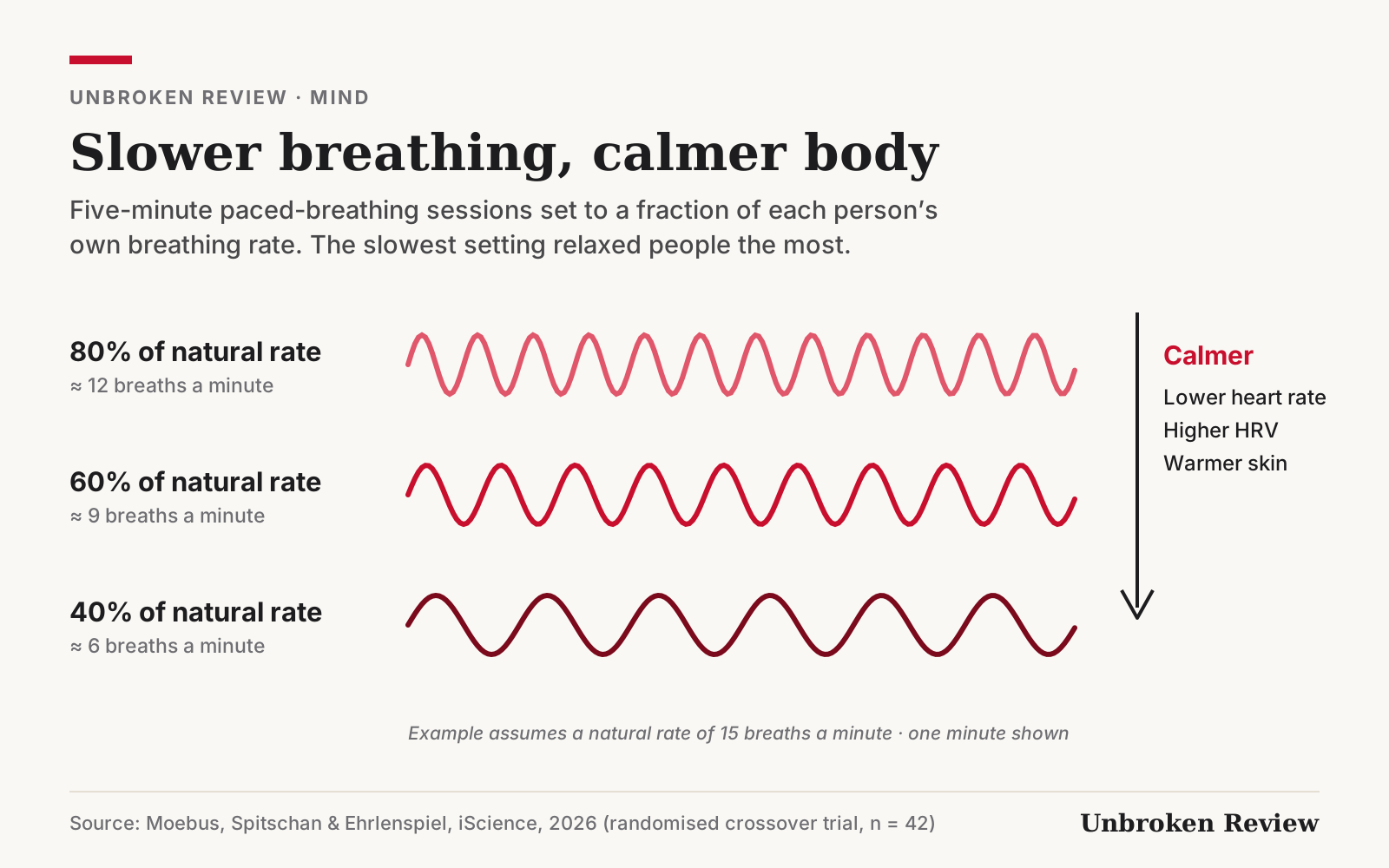
Researchers at the Technical University of Munich and the Max Planck Institute for Biological Cybernetics in Tübingen asked 42 university students to complete three five-minute breathing sessions, in random order. Rather than prescribing a fixed rate, each session was set as a fraction of the person’s own natural breathing rate: 80, 60 or 40 per cent of it.
The results, published in iScience, were consistent. The slower the breathing, the more relaxed participants said they felt, and their bodies agreed. At lower rates, heart rate fell, heart rate variability (HRV) rose and skin temperature at the fingertips increased, all signs of reduced physiological arousal. Brain-wave recordings over the front of the head shifted too.
Two individual differences stood out. People with previous experience of relaxation techniques reported bigger benefits. And participants with more anxious or depressive symptoms reported more perceived stress after slow breathing, a reminder that a technique that calms most people does not calm everyone.
Study two: does the exact rate matter?
The second trial tested a long-standing idea in HRV biofeedback: that each person has a “resonance frequency”, usually somewhere around six breaths a minute, at which heart rate and breathing rhythms reinforce each other most strongly, and that training at that individually measured rate gives the best results.
Researchers in Warsaw randomly assigned 88 people to four weeks of biofeedback breathing practice at either their individually measured resonance frequency, a fixed rate of 0.1 Hz (six breaths a minute), or to a control group.
Both breathing groups reduced perceived stress, anxiety and depressive symptoms compared with the control group, with no meaningful difference between them. A Bayesian analysis gave weak evidence that the two methods were genuinely equivalent. Notably, four weeks of practice did not change participants’ resting HRV.
What it means
Read together, the studies suggest that the details many people worry about matter less than the basics.
Slowing your breathing below its natural rate reliably shifts the body towards a calmer state in the moment, and the slowest rate in the Munich study had the biggest effect. Practised regularly over weeks, slow breathing at around six breaths a minute appears to reduce stress and anxiety symptoms, whether or not the rate is fine-tuned to the individual.
For athletes, that makes slow breathing a simple tool for the moments that matter: before sleep after a late session, in the hours before a race, or after a hard day when the nervous system is still running fast. It does not require equipment or a lab test.
It is not, however, a fix for everything. The finding that people with more anxious or depressive symptoms sometimes felt more stressed afterwards is a useful caution: if a breathing exercise makes you feel worse, it is reasonable to stop, and to seek support for symptoms that persist.


