
MindExplainer
A tired mind makes worse decisions on the field, meta-analysis finds
Pooling two decades of experiments, researchers found that mental fatigue hurt sport-specific decision-making more consistently than any other skill. The implications reach well beyond team sport.

Most athletes know the feeling: a long day of meetings, emails and decisions, and then a training session that feels harder than it should. Sport scientists call it mental fatigue, a state of tiredness brought on by prolonged demanding cognitive activity, and over the past two decades a growing body of research has examined what it does to performance.
A meta-analysis published in May in BMC Psychology brings that work together for the skills that decide games and races: how quickly athletes react, how well they execute technique, and how good their decisions are.
What the researchers did
The team, from Chengdu Sport University in China, searched five databases up to January 2026 for experiments in healthy people that compared a mentally fatiguing task (often a long, demanding computer task such as the Stroop colour-word test) with a control condition, before a sport-specific or sport-relevant test. Nineteen study records met their criteria. Crucially, they analysed the three skill types separately, rather than mixing them together as earlier reviews often had.
What they found
Mental fatigue was associated with poorer performance in all three domains:
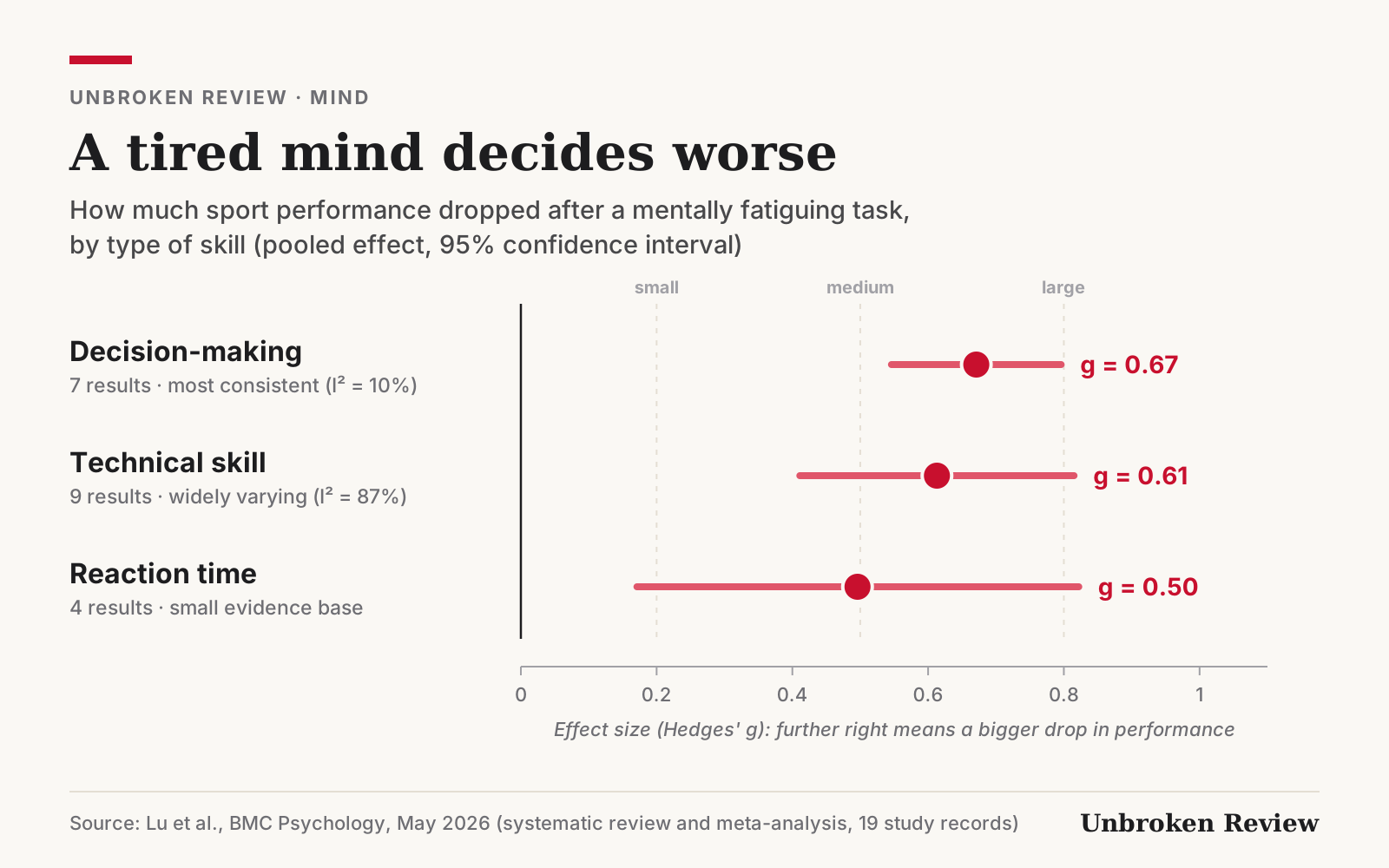
- Decision-making (7 results): effect size 0.67, the largest and, importantly, the most consistent, with very little variation between studies.
- Technical performance (9 results): effect size 0.61, but with large variation between studies.
- Sport-specific reaction time (4 results): effect size 0.50, with the most uncertainty because so few studies measured it.
In the conventional reading of these standardised effect sizes, 0.5 is “medium” and 0.8 “large”. These are meaningful effects, not marginal ones.
Why decisions suffer
The finding fits a broader picture. An influential 2017 systematic review by Jeroen Van Cutsem and colleagues found that mental fatigue impairs endurance performance, and that it does so largely by making exercise feel harder, raising the perceived effort of a given workload, rather than by limiting the heart, lungs or muscles.
Decision-making relies heavily on the brain’s executive functions: attention, inhibition, holding information in mind. Those are the same resources that demanding cognitive work depletes. It is plausible that when they are already taxed, sport decisions (when to pass, when to attack, how hard to push) are the first thing to degrade.
The limits
The authors are careful. Like most of this field, the evidence comes from short, controlled experiments whose fatigue-inducing tasks may not resemble an athlete’s real day. The technical-skill results varied widely, and the reaction-time evidence rests on only four results. They call for future studies to define their primary outcomes in advance and report their statistics more completely.
Why it matters for endurance athletes
Endurance sport is full of decisions: pacing, fuelling, when to respond to a move. For age-group athletes who train around demanding jobs, the research suggests that the hardest cognitive days may be the worst days for sessions that depend on judgement: threshold pacing, race simulations, technical work.
The practical implication is not to avoid training after a hard day at work, but to recognise that mental load is a real training input. On the days when the mind is already spent, a simpler session may be the better one.


