Ronald Korir, fourth in Berlin in 2023, charged in a biological passport case
The 2:04:22 runner is provisionally suspended while the Athletics Integrity Unit pursues the charge. Tokyo winner Ruti Aga was charged in September, and Ethiopia’s Tiruye Mesfin has already been banned for three years.

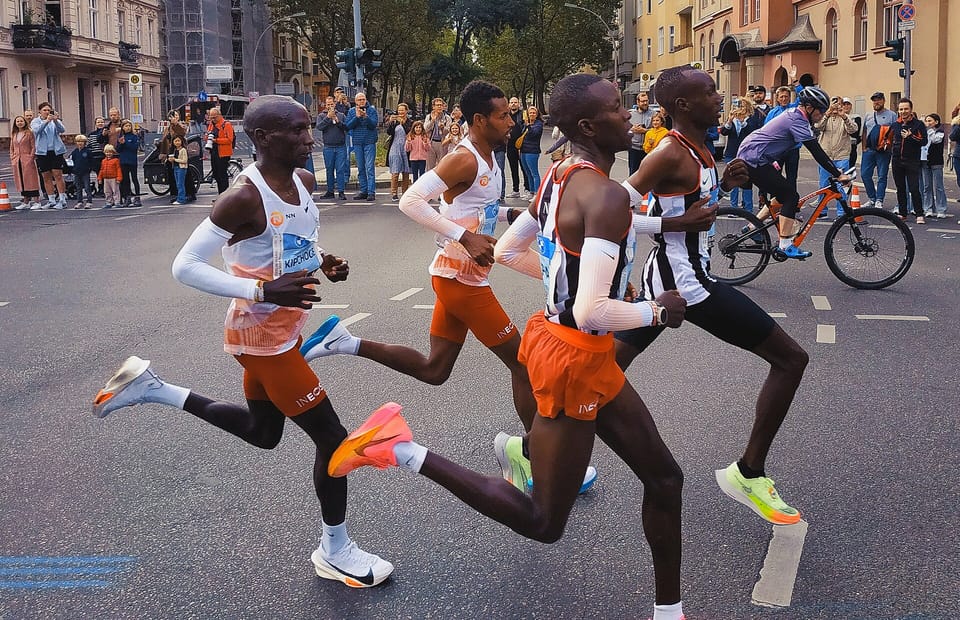
Ronald Kipkoech Korir, the Kenyan who finished fourth at the 2023 Berlin Marathon in 2 hours 4 minutes 22 seconds, has been charged by the Athletics Integrity Unit (AIU) in a case based on his Athlete Biological Passport, and is provisionally suspended.
The AIU’s list of provisional suspensions in force, updated on 13 October, shows Korir with a date of 25 September and the status “Notice of Charge Issued”. The case is listed as “Use of a Prohibited Substance/Method (Article 2.2) - ABP case”. No substance is named, which is usual in passport cases: the charge rests on a pattern in an athlete’s blood values over time rather than on a single positive test.
A provisional suspension is not a finding that a rule was broken. It bars an athlete from competing while the case is decided, and Korir can contest the charge.
Korir is 35, according to AFP, which also reported that he finished fourth at the Hamburg Marathon in 2024. He has not commented publicly.
At least three marathon cases since September
Korir’s is the latest of at least three cases involving elite marathon runners that the AIU has made public since the start of September.
The AIU has charged Ruti Aga of Ethiopia, the 2019 Tokyo Marathon champion, in a case its list dates to 10 September, alleging the presence and use of methylprednisolone, a corticosteroid, and tampering. Reuters reported that Aga, 32, had been issued a notice of charge. Like Korir, she is provisionally suspended and her case has not been decided. The AIU has not said publicly what the alleged tampering involved.
On 4 September, the AIU announced a final decision against Tiruye Mesfin, a 23-year-old Ethiopian who ran 2:18:35 to finish third at the 2024 Valencia Marathon. She was banned for three years after admitting a violation based on her biological passport.
How a passport case is built
Mesfin’s case shows how this kind of charge works. According to the AIU, 17 blood samples were collected from her between December 2022 and November 2025. An expert panel found a pattern indicating blood doping in four samples taken between late June and late August 2025, shortly before the Sydney Marathon, in which she was entered but did not run.
The panel pointed to a rise in haemoglobin together with the lowest reticulocyte (young red blood cell) reading in all 17 samples. It said this was highly likely to have been caused by the use and then withdrawal of a drug such as EPO, or by a recent blood transfusion. Mesfin faced four years but received a one-year reduction for admitting the violation early. Her results from 25 June 2025 onwards are disqualified, including fifth place at the Seoul Marathon in 2026.
“There has been significant progress in the fight against doping in the marathon in the last six to seven years, but there is still a long way to go,” Clothier said in the AIU’s statement. “In this case, thanks to the Athlete Biological Passport, seventeen samples collected over almost three years enabled independent experts to identify a clear pattern that could not be explained by normal physiology or a medical condition.”
Who pays for the testing
The AIU runs a dedicated road running integrity programme covering up to 300 professional road runners, 150 men and 150 women. It is funded by World Athletics, the Abbott World Marathon Majors, World Athletics Label road races, athletes and their representatives, and four shoe companies: adidas, ASICS, Nike and On.
Kenya’s record has drawn particular attention. AFP reported that the AIU has suspended or banned more than 140 Kenyan athletes since 2017. In June the AIU banned Kibiwott Kandie, who set the then half marathon world record of 57:32 in 2020, for seven years after he refused a test in March 2025 and later submitted a document that Kenyan authorities confirmed was fake.
Unbroken Review will report the outcomes of the Korir and Aga cases when the AIU or a disciplinary tribunal publishes a decision.