Pogačar says a later scan found three broken vertebrae from his Vuelta crash, not one
The five-time Tour de France winner says a CT scan in Slovenia in October showed fractures of T1 and T2 as well as the C7 fracture diagnosed in August. He also spoke about two weeks of depression after surgery.

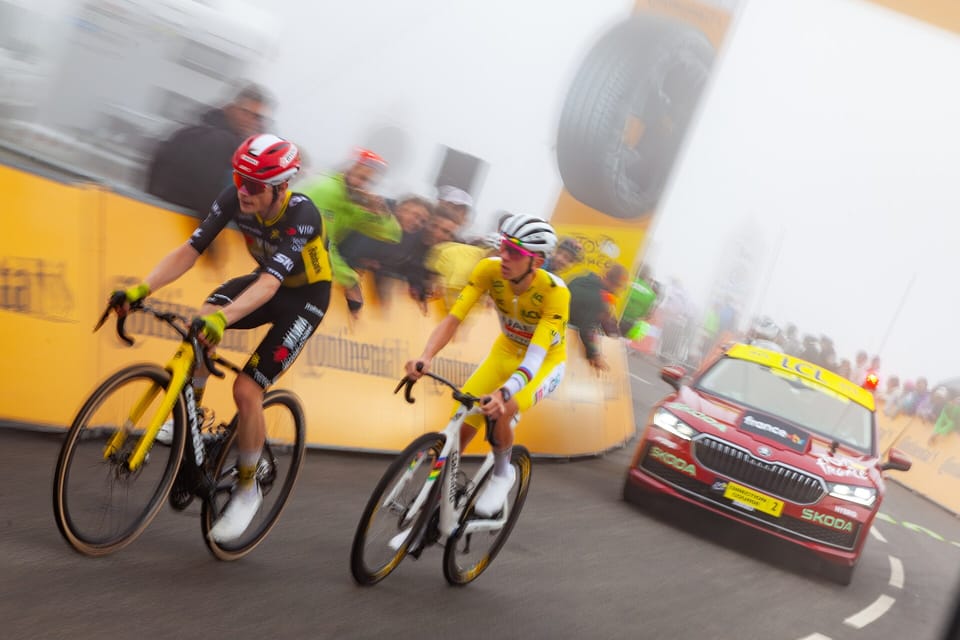
Tadej Pogačar broke three vertebrae when he crashed out of the Vuelta a España in August, not one as first announced, the Slovenian has said in an interview with The Athletic, the sports section of The New York Times, published on 31 October.
His UAE Team Emirates XRG team had reported a stable fracture of the C7 vertebra, the lowest bone in the neck, along with a concussion and a displaced fracture of the left collarbone. Pogačar said a follow-up CT scan in Slovenia in October found two more fractures, in T1 and T2, the first two vertebrae of the upper back.
“I knew I had a C7 fracture, but then we saw I had two more broken vertebrae, the T1 and T2,” he said, as quoted by CyclingUpToDate and Domestique. “When I saw I had three broken vertebrae? I’m just happy to be alive, actually, or just to be standing.”
What happened in August
Pogačar was leading the Vuelta when he crashed a little more than 30 km from the finish of stage 8, to Xeraco, on 29 August, and abandoned the race. On the day, the team’s medical director, Adrian Rotunno, said the rider was stable and had been diagnosed with a concussion, with “no other major injuries and no neurological fallout”, Escape Collective reported.
He had surgery on the collarbone in Barcelona two days after the crash, and the team later said he would not race again in 2026. That ruled him out of defending his world title in Montreal. According to Domestique, he had hoped to race the European Championships in Slovenia but followed medical advice after an X-ray showed the collarbone had not healed much.
“At that moment, I was happy I didn’t do the European Championships, which had been my initial goal,” he said.
“I was really mentally not OK”
The most striking part of the interview was Pogačar’s account of the weeks after the crash. He said he spent two days in bed waiting for surgery, needed the team doctor’s help to shower and became dizzy whenever he stood up or lowered his head.
He contrasted it with his broken wrist at Liège–Bastogne–Liège in 2023, when he said he came round from the anaesthetic “all high” and making jokes. “Now it was completely different,” he said. The operation took an hour and 40 minutes. “I was really depressed after the surgery,” he said.
“For the first two weeks, I was really mentally not OK. I was really down. I was not a fun person to be around,” he told The Athletic, as quoted by CyclingUpToDate. “I don’t think Urska [Zigart] was happy to see me around the house, because I was just, like, depressed. You know, just not feeling anything.”
According to IDLProcycling’s account of the interview, his mood improved once daily physiotherapy and indoor riding began, although progress was uneven, with days of high energy followed by days when he wanted to do nothing.
Back to training, and a point about safety
Pogačar said he has resumed training and is now free of pain. “I don’t have discomfort anymore. I have to be careful not to crash on the bike, or do some heavy lifting with my left arm or with my neck. But I can do basically everything normal now,” he said.
His 2027 programme will not be settled until December, Domestique reported, but he expects to return to the spring Classics, the UAE Tour and the Tour de France.
IDLProcycling reported that he also linked serious crashes to lower safety standards at smaller races, citing fewer police, poorly maintained roads and dangerous finishes with speed bumps, potholes and roundabouts, and that he referred to the death of Finlay Tarling at the Volta a Portugal. The interview came three weeks after riders held up the start of Il Lombardia for five minutes in protest at vehicles entering race routes.