CyclingExplainer
Three millimetres: how a camera taking 13,000 readings a second made Remco Evenepoel European champion
Giulio Ciccone asked to see the “real” finish line. The European federation’s answer explains why a photo finish is not really a photograph.

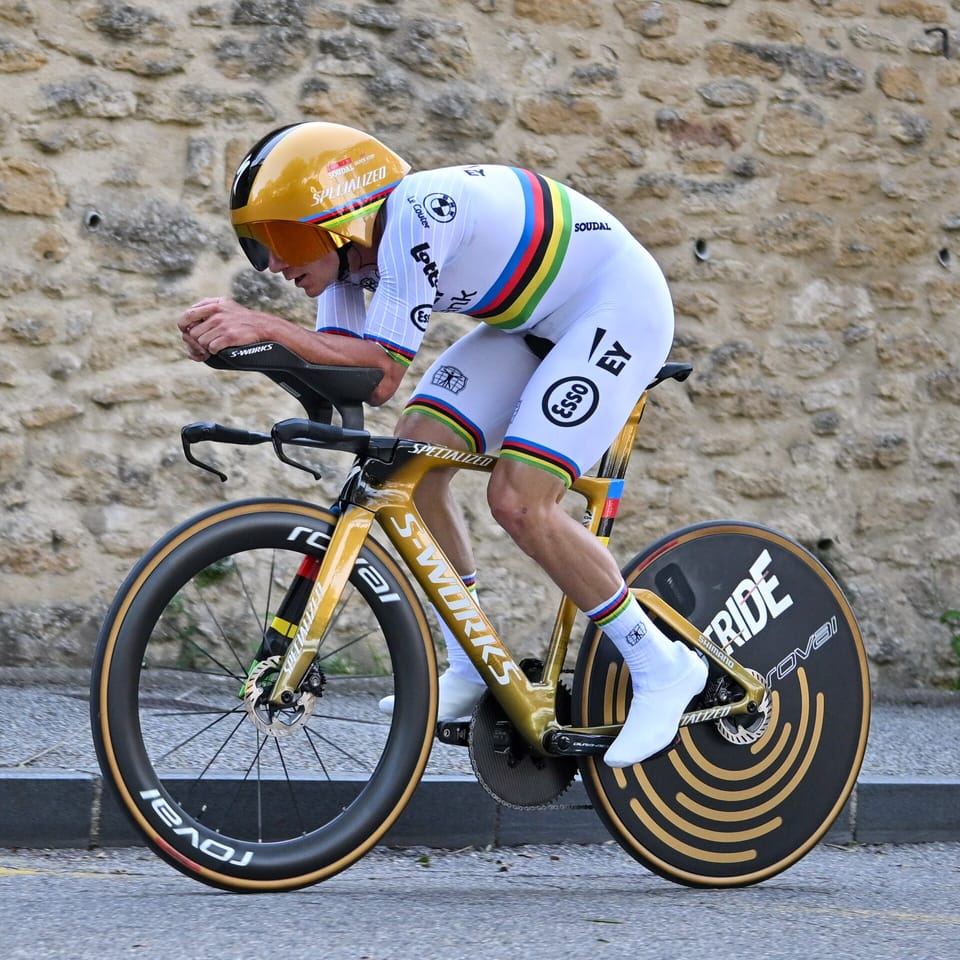
Remco Evenepoel won the men’s road race at the European Championships in Slovenia on 4 October by a margin the race’s timing company put at between 2.8 and 3.3 millimetres. Italy’s Giulio Ciccone, who lost the two-man sprint, publicly questioned the result. The European cycling union, the UEC, has since explained how the result was decided.
A crash, a chase and a bike throw
The 196.3 km race ran from Ljubljana to Šenčur and finished with laps of a circuit that included a 2.1 km climb averaging 10%. On the penultimate climb Evenepoel attacked with Ciccone on his wheel, then lost his front wheel at the summit and crashed. Belgium had enough riders to bring the race back together, and Evenepoel attacked again on a descent a few kilometres later. Again, only Ciccone could follow.
The pair held a lead of almost a minute over the nearest chaser. Ciccone took the inside line through the final corner and opened a small gap, but Evenepoel came back in the closing metres and threw his bike at the line. Neither rider knew who had won until officials announced it. Italy’s Christian Scaroni was third, 59 seconds back.
Why the image looks wrong
Ciccone posted on social media that he wanted to see the “photo finish of the real finish line”, Domestique reported. The UEC’s statement explained why the image might not look the way people expect.
A finish camera of this kind does not take a picture of the scene. It looks only at a narrow strip exactly on the finish line and records that strip over and over. The system used in Šenčur, an EtherLynx Vision PRO X, recorded the line 13,000 times a second, according to the UEC. Those slivers are then placed side by side to build the final image.
“It is important to clarify that the photo finish is not a traditional photograph,” the UEC said. “The horizontal axis represents time and not distance.” That is why wheels, bikes and riders can look stretched or squashed, it added, “with no consequence on the accuracy of the result.”
In cycling, the deciding point is the leading edge of the front wheel, the tangent of the tyre at the moment it reaches the line. The UEC said two independent photo-finish systems were used, giving two separate images to check the result.
How three millimetres was calculated
EvoData, the company that ran the timing, told the Italian magazine Tuttobici that the gap was 0.0002 seconds. At the speed the riders were travelling, that converts to between 2.8 and 3.3 mm, Domestique reported.
The figures are consistent: at about 50 to 60 km/h, a rider covers 14 to 17 metres a second, and 0.0002 seconds at that speed is roughly 3 mm. At 13,000 readings a second, the camera takes a new reading every 0.077 milliseconds, so the winning margin spanned about three of them.
The defending champion, Tadej Pogačar, did not start after the crash that ended his Vuelta a España in August.